Who's moving to Philadelphia?
Where they came from is not the story you'd expect.

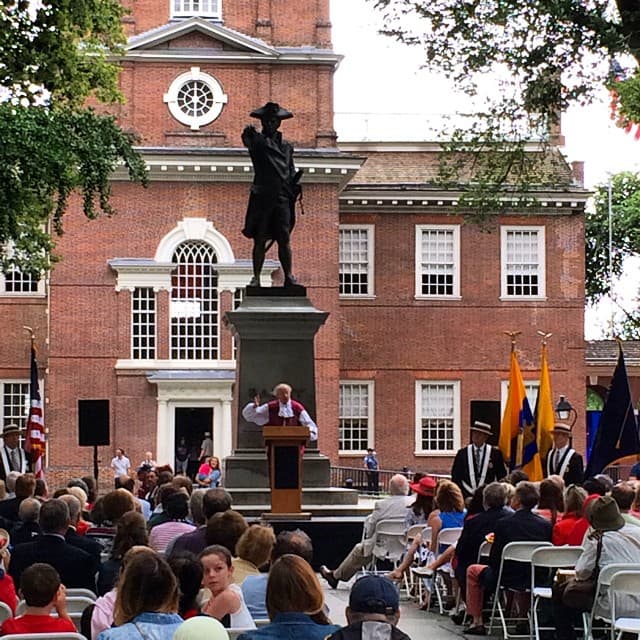
Every year, tens of thousands of people make Philadelphia home for keeps. They file the paperwork, swear the oaths, and put down roots. In fiscal year 2024, exactly 20,240 people became lawful permanent residents in the Philadelphia-Camden-Wilmington metro area, according to newly released data from the Department of Homeland Security's Office of Homeland Security Statistics. That's 20,240 green cards. 20,240 people who chose this city.
Where they came from is not the story you'd expect.
The Dominican Republic sent more new permanent residents to Philadelphia than any other country. Not India. Not Mexico. The Dominican Republic, at 2,660 people, nearly doubling second-place India's 1,850. Anyone who has spent time in North Philadelphia, in Norristown, along Fifth Street or out on Lehigh Avenue, already knows this. The Dominican community has been building here for decades. The 2024 data just makes it official, in numbers.
India and China follow, drawn largely by the anchor institutions: Penn, Drexel, Jefferson, Temple, the hospitals and the tech corridor that feeds them. Together India and China account for 3,140 new permanent residents, a figure that reflects the region's deep graduate-school and healthcare pipelines. The same pattern shows up in the Pakistan and Bangladesh numbers, 580 and 550 respectively. The South Asian corridor into Philadelphia is substantial enough to show up in the regional labor market data and clearly visible in the neighborhoods of West Philadelphia and along Cheltenham Avenue.
But the numbers that stand out most aren't the big ones. They're the ones that punch above their weight nationally.
Uzbekistan sent 590 people to Philadelphia in 2024. That's 11.6 percent of all Uzbek-origin green card recipients in the entire country. Out of roughly 5,000 nationwide, nearly one in eight landed here. Georgia, the country in the South Caucasus, sent 260, which is 10.5 percent of the national total. Belarus, 9.1 percent. Tajikistan, 8.4 percent. Kyrgyzstan, 7.2 percent. Algeria, 9.0 percent. These are not random arrivals. They represent something Philadelphia has that other cities do not: established communities, existing networks, a cost of living that still allows someone without a six-figure salary to build a life. The concentration of Central Asian arrivals in particular likely reflects community networks in the region not widely covered in local media.
The Liberia number tells the same story in starker terms. Liberia sent 440 people to the Philadelphia metro, which is 13.9 percent of all Liberian green card recipients in the country. Philadelphia is the center of the Liberian diaspora in America. Census data and community estimates consistently place the Philadelphia metro as home to the largest Liberian population of any American city, closely followed by Minneapolis. The community in West Philadelphia and in Delaware County is large enough, organized enough, and established enough that new arrivals from Monrovia or Gbarnga know exactly where they're headed.
There are familiar patterns too. Jamaica at 790, reflecting a Caribbean migration stream that runs deep in this region. Vietnam at 610, with a well-established community in South Philadelphia that traces back to the late 1970s resettlement waves. Nigeria at 420. Ghana at 280. Ukraine at 280, a number that likely understates the recent displacement-driven migration from the war zone.
The metro's total of 20,240 places Philadelphia 14th nationally among metro areas by new LPR volume in 2024, slipping slightly from recent years as Sun Belt metros have absorbed more of the post-pandemic backlog clearance. Orlando surpassed Philadelphia for the first time in 2024. The Philly figure is also down from 22,300 in 2023, though well above the 11,880 recorded in the pandemic low of 2020.
What the data can't tell you is the texture. It can't tell you about the Liberian community's anchor churches in Southwest Philly, or the way Dominican businesses have reshaped entire corridors in Hunting Park and Olney. The numbers are a map, not the territory.
But they are a corrective. Philadelphia's immigration story is not a generic American city's story. It is specific, shaped by geography, by history, by the kind of city this has always been. Cheap enough to get a foothold. Connected enough to have networks worth joining. Unglamorous enough that the people who arrive tend to be the ones actually trying to build something, not just park somewhere with good weather.
The Dominican Republic didn't send 2,660 people here because Philadelphia is a global destination city. They came because someone they knew was already here. That's how this place has always worked.