The Rowhouse Problem Nobody Wants to Solve
Examining the complexities of trash collection in a Rowhouse city with few alleyways

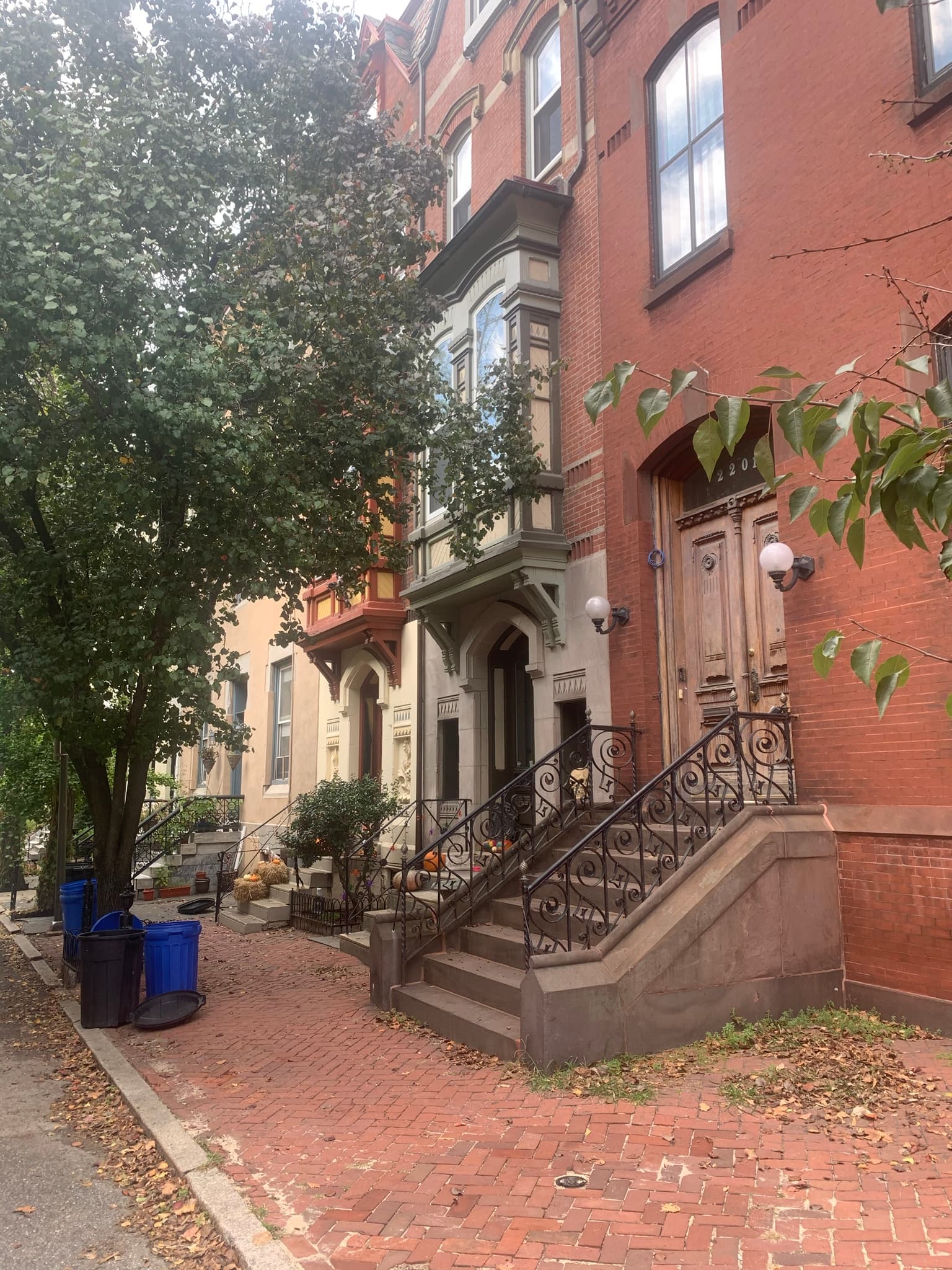
Walk down almost any residential block in Philadelphia on trash night and you'll see the same thing repeated for miles: black bags piled against stoops, sometimes torn open by the time the truck arrives, litter scattered across sidewalks that were swept clean the week before. It's such a familiar sight that most residents stop seeing it. Visitors never stop seeing it.
The reason isn't that Philadelphians don't care about their blocks. It's that the city's housing stock was never built for the way modern cities handle garbage. Rowhouses packed tight against each other, no alleys, no side yards, no room for a proper bin without it swallowing half the sidewalk. Containerized trash, the wheeled-cart, lidded-bin system that has quietly become standard in most American cities, runs into a basic geometry problem here. Where do you even put the thing?
Philadelphia has been circling this question for years now, in fits and starts, one small pilot at a time.
What the city has already tried
Back in 2018, the Streets Department ran a program called PhilaCan, built directly on a Baltimore model. The idea was simple: distribute 35-gallon lidded trash cans to homeowners in a section of North Philadelphia bounded roughly by Broad to 18th and Cecil B. Moore to Cumberland, an area chosen because it was already struggling with some of the worst litter accumulation in the city. Around 2,090 households were eligible. It was voluntary, funded by a state grant, and treated from the start as a test case rather than a citywide mandate.
That pilot answered part of the question. Lidded cans work. They keep animals out, keep bags from splitting, keep the wind from scattering trash across three blocks before the truck even arrives. What the pilot didn't solve, because it wasn't designed to, is what happens when you try to scale a can-per-house model onto blocks where there's no room to store one.
More recently, under Mayor Cherelle Parker's "clean and green" push, the city has leaned harder into frequency rather than containers. A twice-a-week collection pilot launched in Center City and South Philadelphia, and this January the city expanded a similar twice-weekly program into sections of North Philadelphia targeting illegal dumping hot spots. There's also been a separate experiment with extended collection windows between Vine and Bainbridge, letting residents set trash out the night before to spread sanitation trucks more evenly across peak hours.
None of these programs are containerization in the way Baltimore or a European rowhouse city would recognize the term. They're patches. Useful ones, but patches.
The geometry nobody's solved yet
Here's the actual constraint. Philadelphia's own property maintenance code caps front-of-house containers at a fairly modest size, non-combustible, tight-fitting lid, no more than two per house. The citywide sanitation rules are a bit more generous, allowing cans up to 32 gallons or leak-proof bags in that same range. Either way, you're not fitting a standard 96-gallon automated cart on a South Philly sidewalk that's already narrow enough that two people can't comfortably pass with a stroller.
That's the part that makes Philadelphia different from the cities usually held up as containerization success stories. San Francisco, Seattle, most of suburban America, they have driveways, side yards, garages, alleys. Philadelphia's rowhouse blocks mostly have none of that. Where alleys do exist, mostly in older pockets of South Philly and parts of Kensington and Northern Liberties, rear pickup becomes possible in a way it simply isn't on a block that's rowhouse-front, rowhouse-front, all the way down.
So the realistic paths forward split into two categories, and they trade off against each other in ways that are going to make somebody unhappy no matter which one the city leans into.
The first is smaller individual carts, something in the 32 to 35-gallon range like the PhilaCan pilot already tested, stored in areaways, under front steps, or in whatever six square feet of space a rowhouse can spare, and wheeled to the curb only on collection day. It keeps individual accountability intact and doesn't require touching anyone's parking. It also means narrower, more expensive semi-automated trucks instead of the fully automated single-arm trucks that make containerized collection cheap in cities with wider streets.
The second is shared block-corner containers, underground or semi-underground, accessed by fob, serviced by lift trucks a few times a week instead of daily pickup at every stoop. This is closer to what parts of Baltimore, Boston, and plenty of European rowhouse and terrace neighborhoods actually do. It's more efficient at scale. It also means giving up curb parking spots at block corners, and in a city where parking fights can dominate a community meeting for an hour before anyone gets to talk about the actual trash problem, that's not a small ask.
What's actually holding this back
It's not, at this point, a technology problem. The equipment exists. Baltimore already proved the small-can model works on rowhouse blocks not unlike Philadelphia's own. What's holding Philadelphia back is the same thing that's held back most structural fixes to city sanitation: money, political appetite, and the fact that Philadelphia remains the only major U.S. city without a real municipal street sweeping program, which means litter management has always been treated as a downstream cleanup problem instead of an upstream design one.
The twice-weekly pickup pilots are a sign the city is at least willing to spend real money testing something, twelve million dollars for the Center City and South Philadelphia expansion alone. But frequency and containerization solve different problems. More pickups reduce how long trash sits on the curb. Containerization changes what condition it's in while it sits there, and how much of it ends up on the sidewalk instead of in the truck.
Philadelphia hasn't committed to either as its long-term answer yet. What it has is a string of small, geographically bounded pilots, each one testing a different piece of the puzzle without anyone quite stitching the pieces together into a citywide plan. That might be the right approach for a city with this much variation block to block. It might also be a way of avoiding the harder conversation, the one where someone has to decide whether Philadelphia is willing to give up curb parking, or ask 500,000 households to find storage space they don't have, in order to finally get rowhouse blocks looking like something other than trash night.