The Delaware Is About to Build Ships Again
Thirty years after the Navy walked away, Philadelphia has the money, the orders, and the political backing to become the center of American shipbuilding. The only thing left is the work.

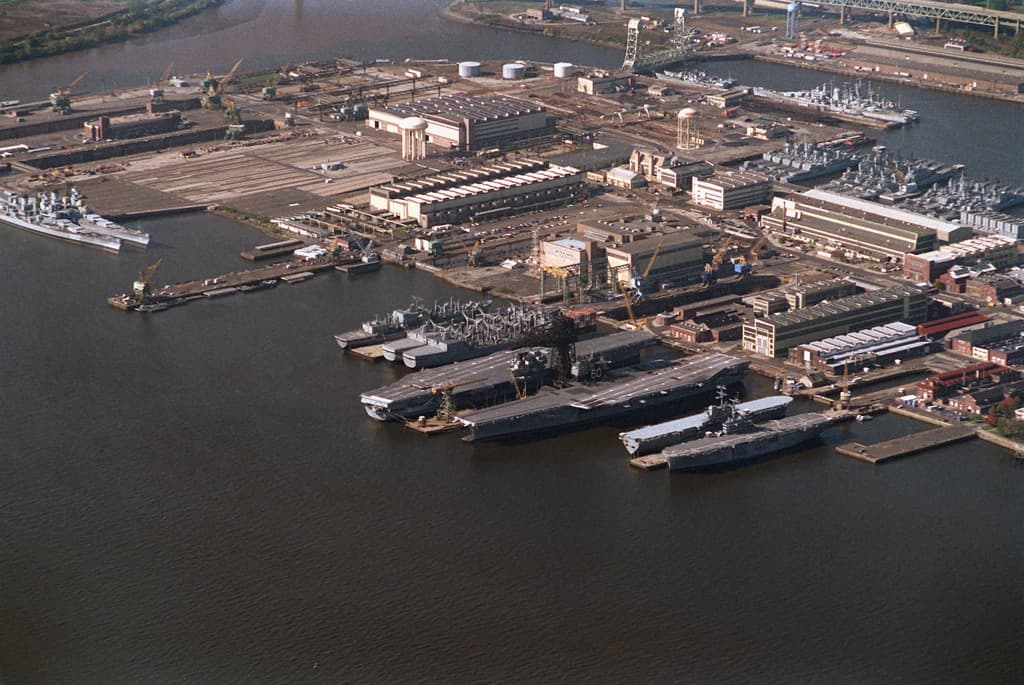
There is a crane at the Navy Yard that was installed in 1942. It still runs. It has outlived the war it was built for, the Navy base that closed around it in 1994, the Norwegian owners who kept the lights on through the lean decades, and every prediction that Philadelphia was finished as a shipbuilding city.
It is about to be surrounded by new equipment, new workers, and the largest commercial vessel order this country has seen in twenty years.
Hanwha bought this shipyard in December 2024 for $100 million. Since then the South Korean conglomerate has put in another $100 million and committed $5 billion more. That is not a rescue package. It is the American beachhead of a $150 billion bet by the government of South Korea, formalized under a program called MASGA, to rebuild an industry the United States allowed to collapse. Seoul chose Philadelphia to prove it can be done.
The scale of the problem is what makes the opportunity so large. China turns out more than a thousand cargo ships a year. The United States turns out a handful. Hanwha's own executives don't soften it: the Philadelphia yard currently delivers about one ship a year. Hanwha's yard in Geoje, South Korea delivers one a week. That is the gap, and closing it is the entire business plan.
The orders are real and they are already signed
In July 2025, Hanwha Shipping ordered an LNG carrier from Philly Shipyard, a $250 million vessel and the first US-ordered, export-viable LNG carrier in nearly fifty years. The last one, the Louisiana, entered service in 1980. A month later came the follow-on: ten medium-range tankers plus a second LNG carrier, together the largest US commercial vessel order in more than two decades and the highest-value commercial order placed at any American shipyard.
The first LNG carrier will be largely constructed at Geoje, with Philadelphia holding the contract, running Coast Guard certification, and taking on the technology transfer. That is the model working exactly as designed. You do not rebuild a fifty-year-dormant capability by starting from a blank sheet of steel. You start by co-building, moving Korean processes and supplier relationships and expertise onto the Delaware, and then you take over. The tankers that follow are the next rung. And a federal rule kicks in in 2029 requiring a share of US LNG exports to move on American-built hulls, which means the market Hanwha is building toward is not speculative. It is legislated.
Meanwhile the yard's existing business keeps delivering. Since 2000, Philly Shipyard has built roughly half of all large ocean-going Jones Act vessels in the United States. This year it laid the keel on the fifth and final National Security Multi-Mission Vessel, the training ships for the nation's merchant marine academies. That is a finished program, on the water, built here.
The workforce is the story
Fifty Korean trainers are on the ground in Philadelphia right now. CEO David Kim has said the yard will add 7,000 to 10,000 workers within two years. Hanwha's automation target is to bring Philadelphia's roughly 25 percent automated welding up toward the 95 percent that Geoje runs, and its production target is twenty ships a year against today's one and a half.
Those are big numbers and they are exactly the numbers a serious industrial buildout produces. This is what it looks like when a company decides to manufacture at scale in an American city: welders, pipefitters, electricians, machinists, thousands of them, in a union town with a fabrication culture that never entirely went away.
Rhoads Industries is the proof that the ecosystem is thickening around Hanwha rather than depending on it. The 130-year-old Philadelphia fabricator is putting nearly $100 million into a new 95,000-square-foot Navy Yard facility built for the Navy's submarine industrial base, backed by a $4 million state grant on top of more than $17 million in Commonwealth support over the past decade. It creates at least 450 jobs, retains 541, and runs its own three-year apprenticeship with Boilermakers Local 19, training to military specification. Pennsylvania put another $30 million into preparing 54 acres of the Navy Yard's Greenway District for advanced manufacturing. The campus already holds more than 15,000 jobs across 150-plus employers, and it is filling up.
The prize is the Navy
Here is where it gets serious. In October 2025, President Trump announced that South Korea would build nuclear-powered submarines at the Philadelphia shipyard. Two months later, Hanwha went further, saying it is prepared to build Virginia-class submarines for the US Navy itself. Hanwha has never built a nuclear submarine, and its argument is that it doesn't need to have: the Virginia-class is a mature, validated design, and a shipbuilder with Hanwha's throughput can climb that curve fast.
The Navy needs someone to. It wants 66 Virginia-class boats by 2054. It has 24. It needs roughly two a year and has averaged 1.2. That shortfall is not a talking point, it is a strategic emergency, and it is the reason a company that can launch a ship a week is being handed an open door.
This July, the door opened wider. The Pentagon sent formal requests for information to Hanwha Ocean and HD Hyundai on destroyer design and construction, the first direct approach to Korean shipbuilders since MASGA launched. An RFI is a first step, not a contract. But it is the step that has to come first, and it puts a hard spotlight on the one law standing in the way: the Byrnes-Tollefson Amendment, which restricts building Navy vessels at foreign yards.
Which is precisely why Philadelphia matters more than Geoje. If Korean shipbuilding capability is going to build American warships, it has to do it on American soil. There is one yard where that is already happening. It is on the Delaware.
Carlisle, July 15
The politics arrive this week. Senator Dave McCormick convenes the Pennsylvania Defense and Innovation Summit at the Army War College on July 14 and 15, with President Trump headlining day two and expected to announce investments and partnerships. Last year's version of this event, in Pittsburgh, produced $92 billion in single-day private-sector commitments, the largest investment announcement in Pennsylvania history.
Michael Coulter, who runs Hanwha Defense USA and gave that one-ship-a-year line to 60 Minutes, is on the speaker list. So are Phebe Novakovic of General Dynamics, Kathy Warden of Northrop Grumman, and James Taiclet of Lockheed Martin, the primes who would build alongside Hanwha on any Navy program. McCormick's frame for all of it is that Pennsylvania built the Arsenal of Democracy and is now building what he calls the Arsenal of Freedom.
Call it branding if you want. The money behind it is not branding. Neither are the tankers, the LNG carriers, the fifty trainers, the 450 jobs at Rhoads, the RFIs at the Pentagon, or the $5 billion Hanwha has already committed to a shipyard it bought for a fiftieth of that.
The 1942 crane is still standing. Not much longer.