The Auction Behind Your PECO Bill
Pennsylvania blames a single PJM auction for the electricity increases hitting every utility in the state. The number that actually reaches a PECO customer travels a longer road than the headlines suggest, and following it explains why Philadelphia pays less than almost anywhere else in Pennsylvania.

A PECO household that never shops for a supplier pays a rate called the Price to Compare. On June 1, 2026 that rate rose to 11.572 cents per kilowatt-hour, up from 11.024. Two years earlier it sat in the 9-cent range. For a home using around 700 kilowatt-hours a month, that climb works out to roughly $15 more every month for the exact same electricity.
Ask why, and almost every answer points to the same place: a PJM capacity auction. The pointing is correct. The explanation attached to it usually is not. The popular version collapses two separate auctions into one, treats a wholesale price as if it were your bill, and skips the part that actually explains why your neighbors in Pittsburgh pay more than you do.
Here is the longer road, and why the details matter.
Two auctions, not one
PECO does not make electricity. It is a distribution utility, an Exelon subsidiary that delivers power to about 1.7 million customers across Philadelphia and the surrounding counties. When you have not chosen a competitive supplier, PECO is obligated to buy generation on your behalf. It does this through its own Default Service Program, a set of competitive procurement auctions PECO has run under Pennsylvania Public Utility Commission approval since 2009. Wholesale suppliers bid to serve PECO's default customers, and the winning bids become the generation portion of your rate.
That is the first auction, and it is the one that sets your number.
The second auction is PJM's. PJM Interconnection is the regional grid operator for 13 states and Washington, D.C. Once a year it runs a Base Residual Auction, where power plant owners are paid not for electricity but for a promise to be available during peak demand. This is the capacity market, priced in dollars per megawatt-day, secured for a delivery year that runs June 1 through May 31.
The capacity auction does not set PECO's rate. It sets one of the costs that suppliers bake into what they bid into PECO's auction. When PJM capacity gets more expensive, suppliers raise their bids, and PECO passes the result through. That distinction is not pedantic. It is the whole reason the same PJM price produces a 5 percent increase for PECO and a 12 percent increase two counties over.
How the capacity price exploded
For four straight delivery years, PJM capacity was cheap and getting cheaper. The rest-of-RTO clearing price fell from $140 per megawatt-day for 2021/2022 to $50, then $34.13, then $28.92 for 2024/2025.
Then it hit a wall. The 2025/2026 auction cleared at $269.92, an increase of 833 percent in a single year. The next auction came in at $329.17, and the one after that at $333.44.
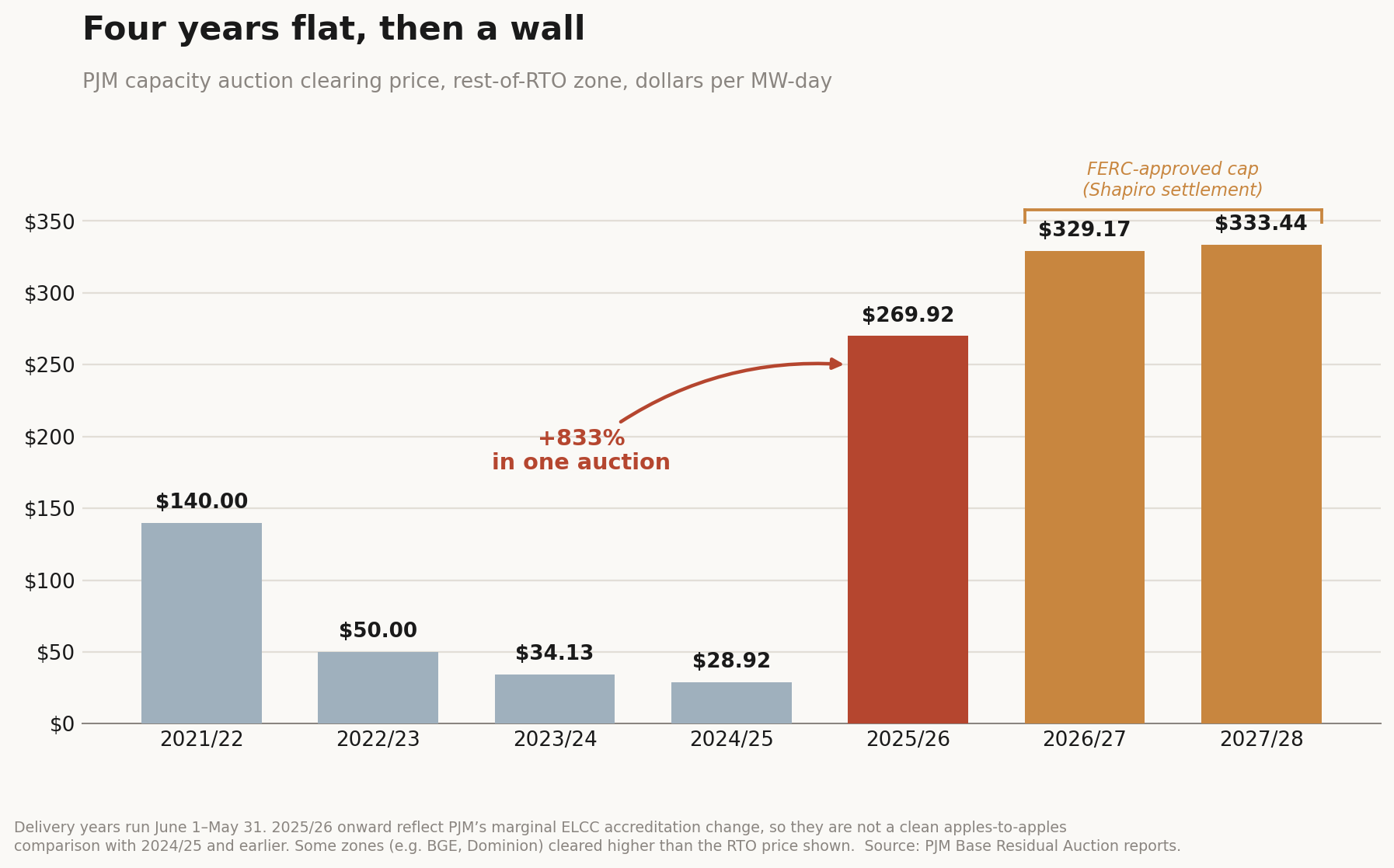
Several forces converged. Older coal plants were retiring faster than new generation could replace them. Demand forecasts jumped, driven above all by data centers and, secondarily, by vehicle and building electrification. Stalled interconnection queues left new projects, including most renewables, waiting years to connect. And PJM changed the way it accredits capacity, a technical shift called marginal ELCC that reduced how much of each resource counts as reliably available at peak. That last point carries a caveat worth stating plainly: because the accreditation math changed starting in 2025/2026, the auctions before and after that line are not a clean apples-to-apples comparison. Part of the jump is a real price signal. Part of it is a change in how the same megawatts get counted.
The long road to your bill
Here is where the popular story goes wrong. An 833 percent capacity increase did not produce an 833 percent bill. It produced something closer to a 25 percent rise in PECO's rate over two years. The gap between those two numbers is the actual mechanism, and it dilutes twice.
First, capacity is only one slice of the generation charge. When suppliers bid into PECO's procurement, their price reflects wholesale energy costs, ancillary services, transmission, alternative-energy requirements, and capacity. Capacity is a meaningful and newly volatile piece of that stack, but it is a piece, not the whole.
Second, the generation charge is only part of the bill. The PUC estimates that generation accounts for roughly half of a typical residential bill or somewhat more, with distribution, transmission, and riders making up the rest. So a capacity spike gets diluted on the way into the generation charge, then diluted again on the way into the total bill.
One more point the "PECO is raising rates" framing obscures: on the generation side, PECO earns nothing. It passes supply costs through at the price it pays, without markup. The utility's profit lives in distribution, the poles and wires. That is a separate charge, and PECO did raise it, with a distribution increase of about 10 percent taking effect in 2025, its first in over a decade. Two different increases, two different mechanisms, and only one of them is PJM's doing.
Why PECO customers pay less than Pittsburgh
The clearest proof that the capacity auction is an input rather than the whole story is that every Pennsylvania utility faced the identical PJM price, and every one of them moved differently.
Two things stand out. PECO customers pay among the lowest default rates in the state, and the June increases ranged from 1.5 percent to more than 12 percent for the same underlying auction. The variation comes from each utility's own procurement timing, its supplier mix, its territory, and when its distribution case last landed. PECO's low rate is partly structural. Density helps. Spreading fixed costs across 1.7 million customers packed into southeastern Pennsylvania costs less per household than serving a rural territory where the same wires reach a fraction of the customers. It is the same reason Duquesne and Penelec sit at the top of the table.
The fight over what comes next
None of this is settled. In December 2024, facing the first spike, Pennsylvania Governor Josh Shapiro sued PJM at the Federal Energy Regulatory Commission, arguing its auction design would saddle consumers with unnecessary cost. The case produced a January 2025 settlement that put a temporary cap and floor on capacity prices, roughly $325 and $175 per megawatt-day, for the next two auctions. Both the 2026/2027 and 2027/2028 auctions cleared exactly at that cap, which is why their bars in the chart sit flat at the top. PJM has said that without the cap, the 2026/2027 price would have reached around $389. In early 2026 the collar was extended through 2030.
The savings figures the Governor's office attaches to this fight, cumulative totals in the tens of billions across PJM's whole footprint, are worth reading as the administration's estimates rather than settled accounting. They describe money not spent under a counterfactual, not a line item on anyone's bill.
The larger question is demand. Data centers are the driver everyone is now fighting over. Nearly all of the forecast load growth in the most recent auction traced to them, and PJM projects summer peak demand could climb sharply over the next decade. PJM's own independent market monitor has floated what amounts to a moratorium on new data centers that do not bring their own generation, and PJM has proposed rules to push large new loads toward building their own power. Whether data centers pay their own way, and how, is the policy question that will shape the next several years of Pennsylvania electric bills.
What you can actually do about it
The generation portion of your bill is the part you can change. Under Pennsylvania's 1996 competition law, you can buy generation from a licensed supplier while PECO keeps delivering your power. The Price to Compare is exactly that, the number to beat. If a supplier's fixed rate is below PECO's current rate, you save on the generation line immediately.
Three cautions. The PUC notes that this year has fewer offers below the utility rate than in the past, and that some of the ones below it are short teasers of three to six months that reset higher. Variable-rate plans can move against you with no warning. And shopping only touches generation. Distribution charges, and the PJM transmission charges PECO recovers from every customer, stay on your bill no matter who supplies your electrons.
Compare offers at PAPowerSwitch.com, the PUC's official marketplace, and read the term length and expiration before you sign. The auction that set your rate is out of your hands. The rate you pay against it is not.