Philadelphia - The Cyberpunk City
Gene-edited immune cells, an artificial womb, a skyline lit like a circuit board, and a record-violence peak beaten back by drones and forensics. The genre spent forty years imagining a city like this. Philadelphia became one.

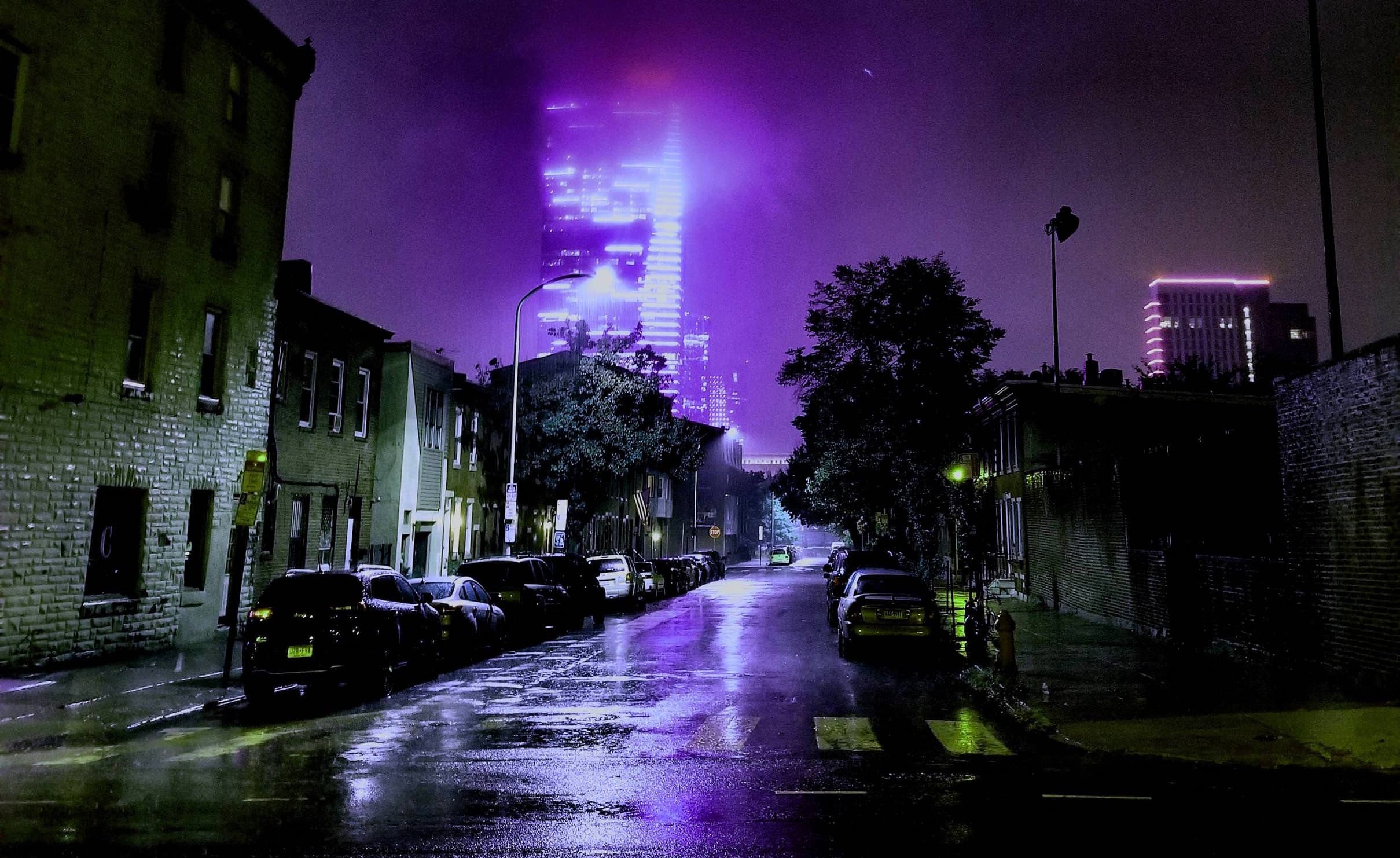
Cyberpunk was never really about the future. It was about a specific arrangement of the present, written large and lit in neon. Glowing towers owned by corporations whose research can rewrite the human body, ringed by neighborhoods the same companies barely acknowledge. High technology, low life. The hacker in the alley below the arcology.
For decades the genre borrowed its skyline from Tokyo and its grime from a stylized Los Angeles. But the most complete version of that arrangement sits on the Delaware River. Philadelphia spent the early 2020s living through the most violent stretch in its recorded history while, a few miles west, its laboratories were curing inherited blindness, growing premature lambs inside plastic bags, and teaching the immune system to hunt cancer cell by cell. The neon went up over Center City at the same time. The pieces did not just coexist. They sat on top of each other.
The skyline already looks the part
Philadelphia's skyline has been a programmable light rig since 1987, when One Liberty Place went up at 16th and Market with lighting designed to trace its angled crown and spire. It set the template. Nearly every major tower built since has arrived with a decorative lighting package, and the result at night is a skyline that behaves less like a row of office buildings than like a set of screens.
The Comcast Technology Center, a 1,121-foot glass-and-stainless tower designed by Norman Foster's firm, carries a vertical "lantern" of programmable LEDs running up its west face, lighting floors 6 through 60. Comcast pitched the building, when it announced it, as an engine for the city's evolution into a technology hub on the order of Silicon Valley. Down the skyline, the FMC Tower in University City hides hundreds of LEDs behind its glass that turn the whole façade into a single animated surface each night. City Hall has been illuminated from its base to the William Penn statue since 2004, and the Center City District has wired the façades of a dozen historic buildings along the Avenue of the Arts for programmed color.
The whole array can now shift in near-unison. When the Eagles reached the Super Bowl, both Comcast towers turned green for the first time in either building's history, joining a coordinated display the local press fairly described as a rainbow fashion show. That is the cyberpunk skyline exactly, a corporate light grid that the city can repaint on command. The genre usually has to invent that. Philadelphia just built it.
The body shops of "Cellicon Valley"
The harder, stranger half of the genre is the technology that reaches into the body, and this is where Philadelphia stops resembling a movie set and starts outrunning one. The city's cluster of cell and gene therapy labs has earned the nickname "Cellicon Valley," and the work coming out of it reads like a screenwriter's wish list.
Start with the most foundational. The modified messenger RNA at the core of the Pfizer-BioNTech and Moderna COVID vaccines traces to a discovery Katalin Karikó and Drew Weissman made at the University of Pennsylvania, where they figured out how to alter the building blocks of RNA so the body would accept it as instruction rather than attack it. They won the 2023 Nobel Prize in Medicine for it. The premise is pure genre. You write a sequence, inject it, and the body manufactures the protein you asked for. Weissman's lab at Penn's Institute for RNA Innovation is now aiming the same platform at influenza, herpes, and a pan-coronavirus shot.
Then there is the gene splicing that gave a name to the fear and the hope around this technology in the first place. In 2017 the FDA approved Luxturna, the first gene therapy in the United States for an inherited disease, developed by researchers at Penn and Children's Hospital of Philadelphia and commercialized by the Philadelphia spinout Spark Therapeutics. It treats a rare inherited retinal disorder by injecting a corrected gene directly into the eye. Patients who had been functionally blind since childhood described seeing stars and the moon for the first time. A therapy that rewrites a faulty gene and restores sight is the kind of thing the genre treats as a plot device. Here it has a price tag, roughly a million dollars for both eyes, which is arguably even more on-theme.
The same campus produced the first FDA-approved CAR-T cell therapy, Kymriah, out of Carl June's lab at Penn in 2017. The process extracts a patient's own T cells, genetically reengineers them to recognize and kill cancer, and infuses them back as what the field openly calls a "living drug." June's team has since published some of the first peer-reviewed US evidence that CRISPR-edited immune cells can survive and keep working inside cancer patients, performing multiple precise gene edits during manufacturing. Engineered cells, hunting disease, persisting in the body for years. The language the researchers use is not metaphor. They are describing what the cells actually do.
And then there is the artificial womb, which is the moment most people stop and reread the sentence. At CHOP, a team led by fetal surgeon Alan Flake built a system it calls EXTEND, better known by the device at its center, the Biobag. It is a sealed, fluid-filled pouch of synthetic amniotic fluid connected to the umbilical cord, with the fetal heart circulating blood through an external oxygenator and no mechanical pump. In 2017 the team sustained extremely premature lambs inside it for up to four weeks, with normal lung and brain development, at a stage equivalent to 23 to 24 weeks of human gestation. The startup carrying the work toward people, Vitara Biomedical, has raised more than $100 million. (Worth verifying the current status before publishing. As of the FDA's 2023 advisory review the team was seeking approval for the first human trials, and I have not confirmed whether any have since begun.) The intent is narrow and humane, a better option than a ventilator for the most fragile premature infants. The image is something else entirely. A developing mammal, growing inside a translucent bag, on a workbench in West Philadelphia.
The low life the genre requires
Cyberpunk does not work without the street. The miracle technology has to sit over something broken, or it is just a brochure. Philadelphia supplied that too, and the way it did is the most cyberpunk part of the whole story.
In 2021 the city recorded 562 homicides, the single worst year in its history. Residents that year averaged nearly eleven killings a week, and people described the constant gunfire as something close to lawlessness. That is the genre's baseline condition, the dense and dangerous ground floor beneath the glowing towers, and for a stretch Philadelphia was living in it.
What happened next is where the script turns. The city did not simply wait the violence out. It engineered the decline with the exact apparatus the genre obsesses over. Police leaned on license plate readers, drones monitoring high-risk blocks, and forensic analysis of social media to identify suspects, paired with specialized "shooting investigation" detective units assigned to work nonfatal shootings as hard as homicides. That last move turns out to matter enormously, because clearing a nonfatal shooting tends to prevent the next one. The clearance rate for homicides hit about 82 percent in 2025, the highest since the 1980s. Alongside the surveillance and forensics ran a parallel track of community violence intervention, grassroots groups walking the same corners, mediating conflicts before they turned into shootings.
The result was one of the fastest violence declines of any large American city. Homicides fell 35 percent from 2023 to 2024, the largest single-year drop in sixty years, and kept falling. The city closed 2025 with 222 homicides, down about 60 percent from the 2021 peak and the fewest since 1966. Surveys show residents have started to feel it, with more people reporting they feel safe in their neighborhoods at night than did during the spike.
This is not a story about a city that escaped its dystopia. It is a story about a city that fought its way out using drones, algorithms, networked cameras, and forensic data mining, the same toolkit cyberpunk built its anxieties around. The progress is real and worth celebrating. It is also, in its mechanics, the most genre-perfect thing Philadelphia has done. And the violence has not been evenly distributed in its retreat any more than it was in its arrival. From 2022 to 2024, 92 percent of the city's shooting victims were Black or Hispanic. The towers light up for everyone. The ground floor was never shared equally.
High tech, low life, same zip code
Drop the four threads onto a map and the genre assembles itself. The reengineered immune cells and the gene-corrected retinas come out of University City and the labs along the western edge of Center City. The artificial womb sits at CHOP, a few blocks from there. The programmable light grid runs along Market and Broad. And the neighborhoods that lived through 2021, and that are now watching the gunfire recede under a sky full of drones, are often within sight of the same towers.
That proximity is the entire point. Cyberpunk is not about any one of these things. It is about the distance between them being short, about the miracle and the wreckage sharing a skyline. Most cities that fit the look have to stylize themselves into it. Philadelphia got there by being exactly what it is, a 350-year-old industrial city that happens to host one of the densest concentrations of body-altering science on earth, lit at night like a circuit board, having just clawed its way out of the most violent chapter in its history with machines.
The genre spent forty years imagining a city like this. Philadelphia went ahead and became one.