Philadelphia's Prices Are Rising Faster Than Almost Anywhere Else in the Country
Philadelphia has spent years with a reputation as the affordable alternative to New York, Boston, and Washington.

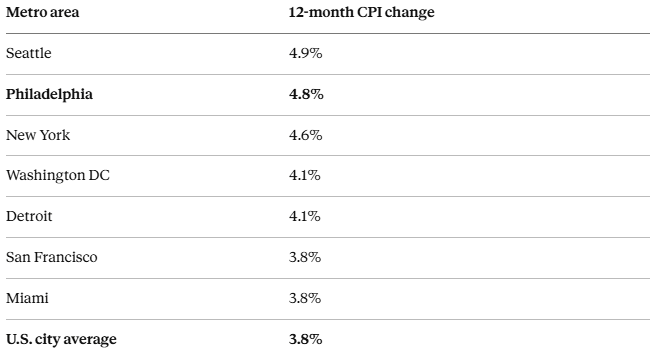
Philadelphia has spent years with a reputation as the affordable alternative to New York, Boston, and Washington. The data no longer backs that up, at least not on the question of how fast prices are climbing. As of April 2026, the Philadelphia metro area's consumer prices were up 4.8 percent from a year earlier, the second-highest inflation rate among the large U.S. metro areas the Bureau of Labor Statistics tracks closely, trailing only Seattle.
That puts Philadelphia ahead of New York, ahead of Washington DC, ahead of every other Mid-Atlantic and Northeast metro in the BLS sample, and nearly a full point above the national average of 3.8 percent.
How Philadelphia stacks up right now
The BLS prices large metro areas on a rotating bimonthly schedule, so not every figure below comes from the identical month. Most of these readings are from April 2026; Washington's is from May, the most recent available; Boston's is from March, the oldest in the group because of its reporting cycle. The gaps are a function of how BLS staggers its survey work, not a sign that any one city's number is stale or unreliable.
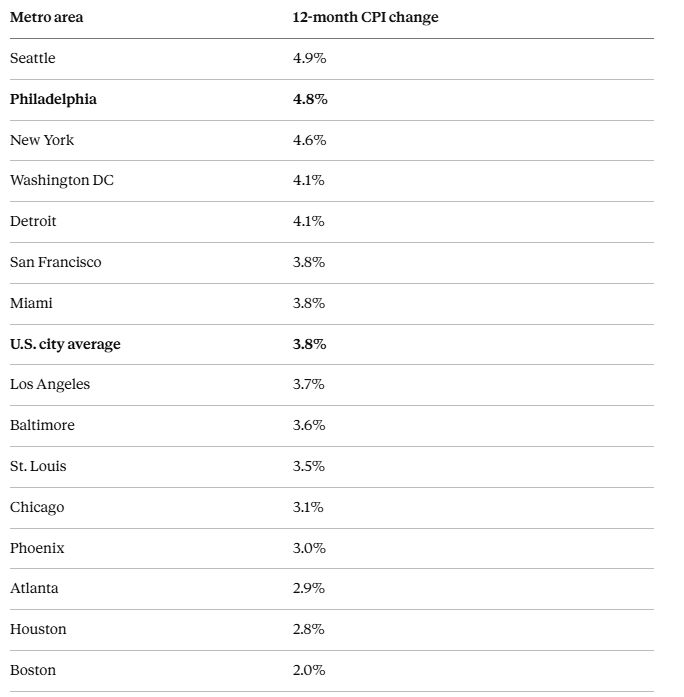
The pattern is not subtle. Of the major Northeast and Mid-Atlantic metros, the cities most often compared to Philadelphia on cost of living, every one is running cooler. New York is two-tenths of a point behind. Washington is seven-tenths behind. Baltimore, the closest regional peer by both geography and economic profile, is more than a full point behind. Boston, often cited as the priciest Northeast city in absolute terms, has the lowest inflation rate of any metro in this comparison.
This is a recent reversal, not a constant
Philadelphia's current position near the top of the inflation rankings is a break from where it sat for most of the post-pandemic period. Through 2022 and 2023, Philadelphia's inflation rate tracked at or below the national average, consistent with its longstanding reputation as a comparatively affordable big city. That changed in 2024. Philadelphia inflation crossed above the national rate and has stayed there since, with the gap widening through 2025 and into 2026.
The cumulative effect is significant. Measured from a December 2019 baseline, prices in the Philadelphia metro area have risen roughly 31 percent, compared with roughly 30 percent nationally. The two lines tracked closely for years and only recently came apart, but once they did, Philadelphia did not just edge ahead. It pulled into the upper tier of large American metros.
What's driving it
Energy is the clearest culprit. In the most recent Philadelphia release, energy prices were up more than 20 percent year over year, with gasoline alone up over 30 percent, among the steepest increases of any category in the local market basket. Core inflation, which strips out food and energy, is running closer to 3.8 percent, still elevated but less dramatic than the headline number. Shelter remains the largest single contributor to that core figure, with owners' equivalent rent up close to 4.6 percent over the year.
Washington's most recent release tells a similar energy-driven story regionally, with gasoline up over 40 percent year over year there, the steepest increase the DC metro has seen since mid-2022. That suggests at least part of what's pushing Philadelphia's number up is a broader Mid-Atlantic and Northeast energy cost pattern, not something isolated to the city. But Philadelphia's overall rate is still outpacing Washington's by seven-tenths of a point, so energy costs alone don't fully explain the gap.
The bottom line
Philadelphia's affordability narrative was never purely about inflation rates, it was about a lower cost base to begin with. That part of the story hasn't changed. But the rate at which prices are climbing has flipped from below-average to among the fastest in the country, and the shift has held for two years running. If the current trajectory continues, the gap between Philadelphia's cost base and its inflation rate will keep closing, and the city's traditional pitch as the affordable option in the Northeast corridor will get harder to make on the numbers alone.