FMC is staying put. A win for Philly.
After months of uncertainty, the 143-year-old chemical company is staying exactly where it started.

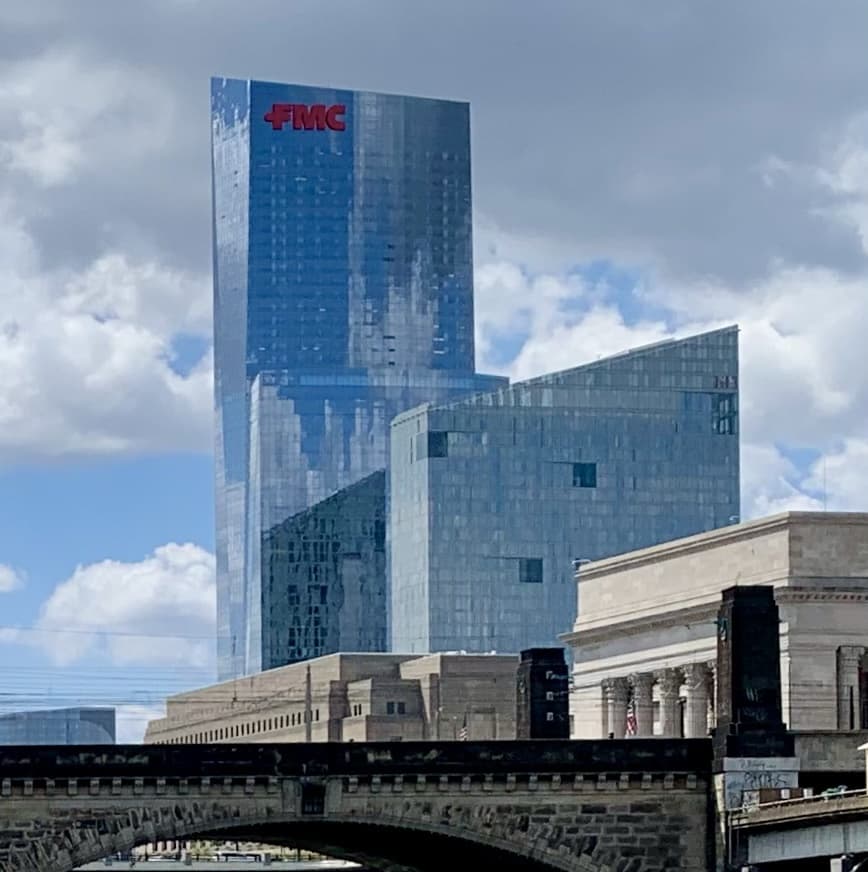
For months, FMC Corporation's future has been an open question. The agricultural sciences giant, headquartered in Philadelphia since its founding in 1883, launched a strategic review back in February, the kind of process that so often ends with a sale, a merger, or a headquarters relocated to wherever the acquirer happens to live.
That review has an answer now, and it's a good one for this city.
FMC announced a deal with Tessenderlo Group, a Belgian industrial company, for a $400 million minority equity investment. Tessenderlo will end up owning about 20 percent of FMC's outstanding shares, and the cash goes toward paying down debt as FMC works toward a roughly $1 billion reduction target. In a separate statement the same week, FMC confirmed it will continue operating its global R&D headquarters at the Stine Research Center.
That's not a footnote. It's the outcome that matters most to a city that has already watched too many corporate names disappear from its skyline and its tax rolls.
Why the review mattered
FMC has not had an easy few years. Shares have fallen roughly 90 percent from their post-pandemic highs, weighed down by inventory destocking across the agricultural chemicals sector, the loss of patent protection on older products, and a debt load that became increasingly hard to carry. Net debt sits around $4.15 billion against an EBITDA base that has been shrinking, not growing, pushing leverage into the 5x to 6x range that makes credit rating agencies nervous and boards defensive.
The company sold its India commercial business in May for $252 million, a price that struck some analysts as light given the size of that operation, a sign of how much leverage buyers had in negotiating with a seller under pressure. FMC also had to price $1.2 billion in new senior secured notes at 8 percent interest, upsized from an original plan of $750 million, just to refinance debt coming due this year. Investors did not love the terms. The stock dropped about 9 percent the week it was announced.
The Tessenderlo deal arrived alongside a broader list of moves FMC has made to shore up its balance sheet. The company amended its revolving credit facility for covenant relief, signed a supply and license agreement with Corteva that included a $200 million prepayment, and agreed to a $114 million sale and leaseback of a property in Newark, Delaware. That last one is worth naming specifically so it isn't confused with the headquarters question. Newark is a manufacturing and operations site, not Philadelphia, and a sale-leaseback there is a financing tool, not a sign FMC is shrinking its footprint in this city.
Against that backdrop, a strategic review announced in February could have gone anywhere. Private equity buyers circling a distressed but strategically valuable chemicals company are not known for sentimental attachment to a headquarters address. Neither are corporate acquirers who already have their own campuses.
What the outcome actually protects
The Tessenderlo deal is a minority investment, not a takeover. FMC remains an independent, publicly traded company, still run out of Philadelphia, still building its next generation of crop protection chemistry at Stine. That distinction is easy to miss if you're only skimming headlines about a foreign company buying a fifth of an American firm, but it's the whole story here. Tessenderlo is providing capital, not relocating an operation.
For a city built on a legacy of pharmaceutical and chemical manufacturing, that continuity carries weight beyond FMC's own balance sheet. Corporate headquarters anchor more than jobs. They anchor civic philanthropy, they anchor the tax base, and they anchor the kind of institutional knowledge that keeps a research community intact across generations of scientists. Philadelphia has spent decades absorbing the departure of corporate names that once defined entire neighborhoods and industries. Every time one stays instead of leaves, it's worth saying so plainly.
FMC still has real work ahead. The company posted a net loss of $261 million in the first quarter, its dividend is being paid out despite negative free cash flow, and the market will be watching closely when second quarter earnings land on July 29. None of that changes on account of the Tessenderlo investment.
But the question of where FMC does that work has been answered, at least for now. It's still Philadelphia. In a year when the city is already leaning into its identity for America's 250th anniversary, that's one more piece of institutional continuity worth holding onto.